Extending trade credit without a plan is a bit like lending money to a friend “for a while.” It usually works out fine — until the one time it doesn’t. A B2B credit limit is simply the ceiling you set on how much a customer can owe you at any point, based on their ability and track record of paying you back. Get this number right, and you protect your working capital while still winning repeat business. Get it wrong, and you’re quietly financing your customer’s growth with your own cash.
This guide walks through what a B2B credit limit actually means, why credit limit management matters more for Indian MSMEs than most owners realize, and how to calculate a customer credit limit step by step — using GST, Udyam, and MCA verification, payment history, and some basic risk scoring. We’ll also get into review cycles, the mistakes people keep making, and a worked example you can adapt for your own business.
What Is a B2B Credit Limit?
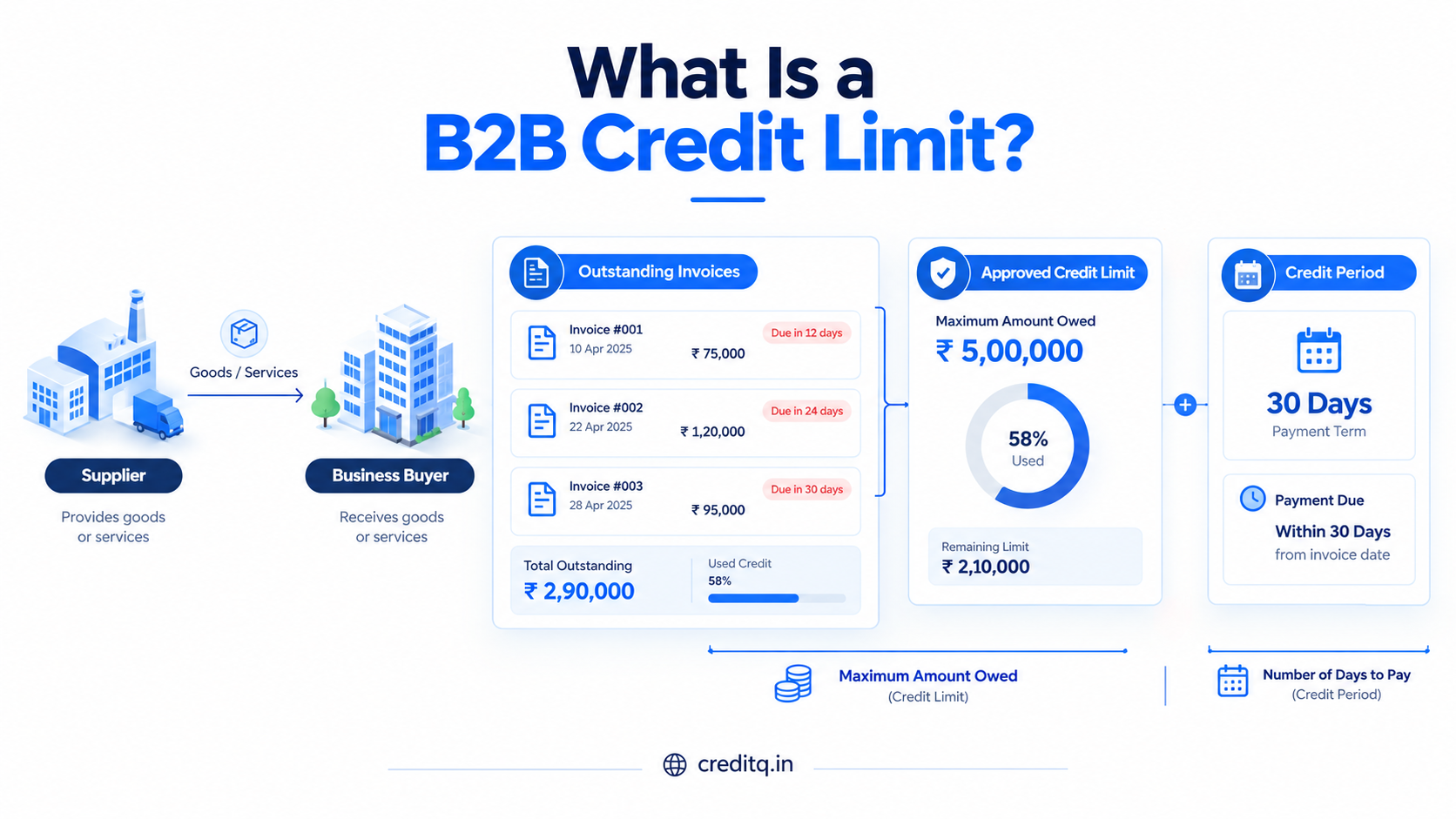
A B2B credit limit is the maximum outstanding balance you’re willing to let a customer carry before you require payment. In practice, it caps your exposure to any single buyer. Think of it as the line beyond which you stop shipping on credit until some of the existing dues get cleared.
This sits inside the broader idea of trade credit, where a supplier lets a buyer pay after delivery instead of upfront. A business credit limit typically covers:
- The total value of unpaid invoices you’ll allow at one time
- The payment terms attached — net 30, net 45, whatever you’ve agreed
- Per-order or per-invoice caps that sit inside the overall limit
A related but separate idea is the credit period — the number of days a customer gets to pay an invoice. The credit limit, on the other hand, is about how much they can owe in total. A customer might have a 30-day credit period and still bump against a ₹5 lakh credit limit if they keep ordering before clearing older invoices. Both work together in most credit policies, and mixing them up is a surprisingly common source of billing disputes.
Why Credit Limits Matter for Cash Flow and Risk Management
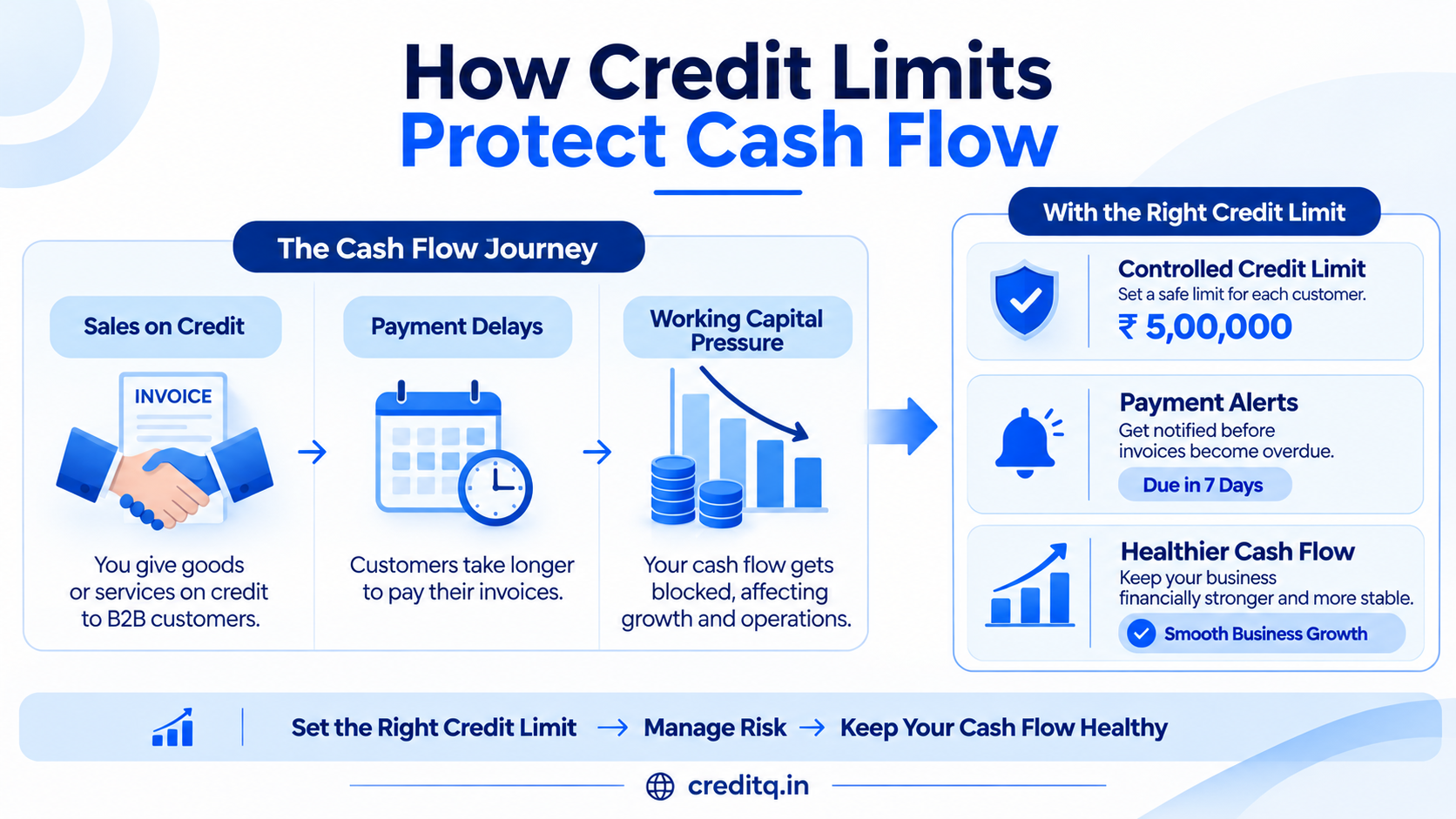
Poorly managed credit limits are one of the quieter reasons MSMEs run into working capital trouble. You make the sale, book the revenue on paper, and then wait — sometimes months — for the cash to actually land. Your suppliers, salaries, and rent don’t wait with you.
This is where credit risk management earns its keep. A sound B2B credit management approach does three things: it limits how much any one customer can owe you, it flags early warning signs before dues pile up, and it stops you from becoming financially dependent on two or three large accounts. Indian MSMEs, in particular, often face delayed payments from larger corporate buyers, which puts pressure on already tight working capital cycles. A credit limit isn’t about distrust. It’s a guardrail that keeps growth from quietly starving your cash position — and honestly, the businesses that skip this step are often the ones surprised by a cash crunch during a growth quarter, not a slow one.
Key Factors and How to Evaluate a Customer’s Creditworthiness
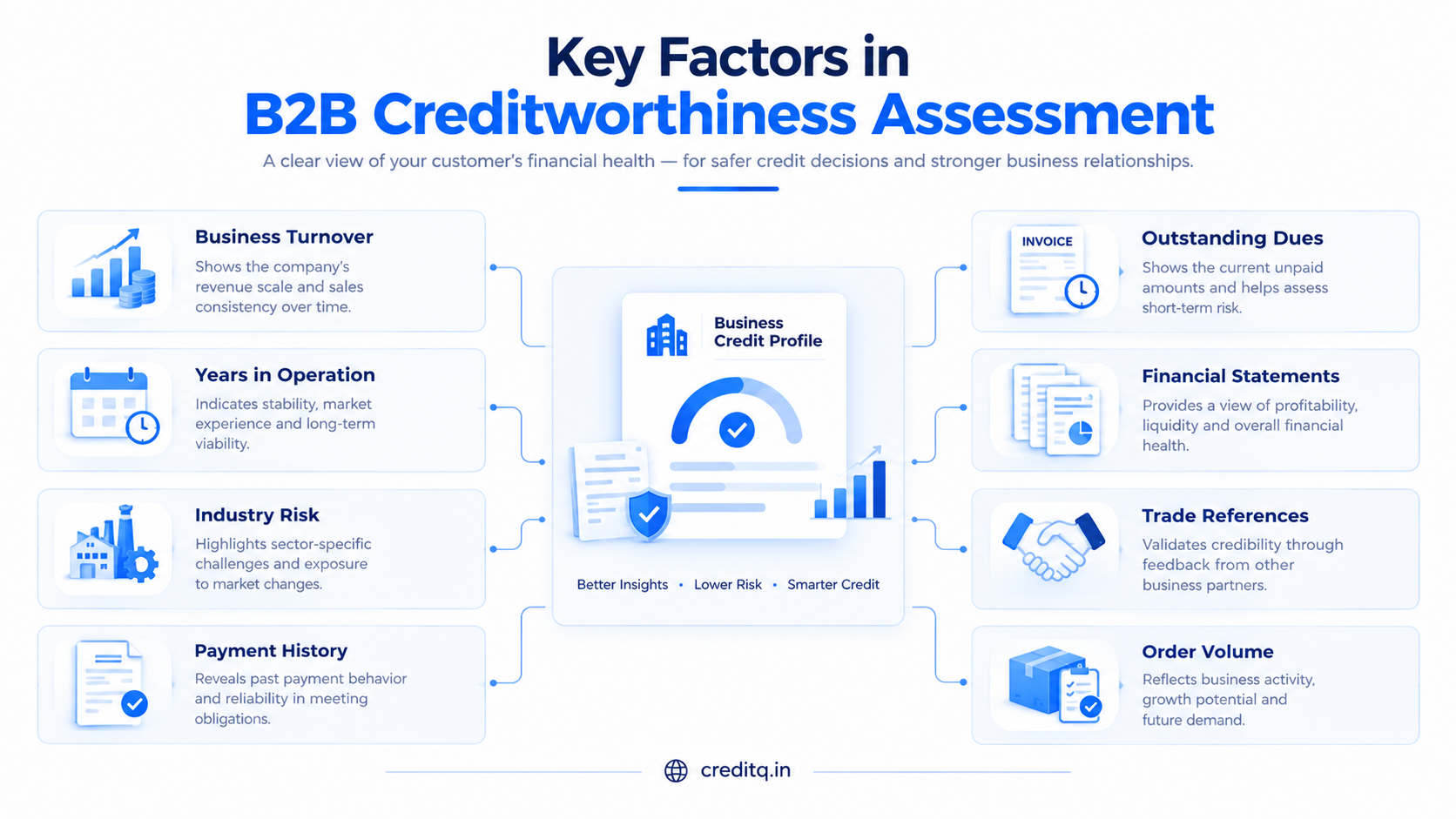
Several factors affect B2B credit limit decisions, and no single data point tells the whole story. You need a combination.
- Business size and turnover, since larger, established buyers can usually absorb bigger order volumes responsibly
- Years in operation — a business running five-plus years has a track record; a six-month-old entity simply doesn’t
- Industry risk, because sectors with long payment cycles (construction, infrastructure) carry inherently higher risk than fast-turnover retail
- Payment history — how promptly has this customer paid you and other suppliers in the past?
- Outstanding dues elsewhere, which is a red flag even if they’ve paid you on time so far
- Financial statements, since balance sheets and cash flow statements reveal liquidity and solvency
- Bank and trade references — other suppliers and bankers often know things your own ledger doesn’t
- Order volume and margins; a customer buying in bulk at thin margins deserves closer scrutiny than one buying less but more profitably
Business verification is the foundation here. In India, that typically means checking GST registration status and filing regularity, confirming Udyam registration (which signals MSME status and can affect payment-term expectations under MSME regulations), and reviewing available MCA filings for registered companies. MCA records generally include details like director information, charges registered against company assets, and statutory filing compliance — useful signals, though how much depth you get varies by company type and filing history.
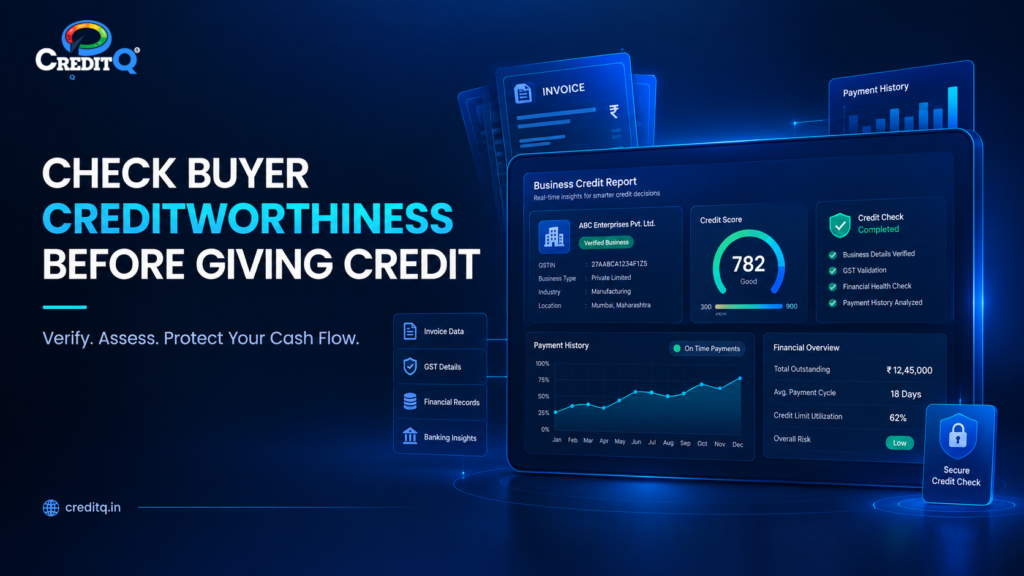
Before extending trade credit, businesses should check a buyer’s creditworthiness by reviewing payment behaviour, business information and available credit records.
Financial risk assessment and payment behavior history matter just as much as the paperwork. A customer who’s verified as legitimate can still be a slow payer — verification tells you who they are, not how they’ll behave. This is exactly where credit intelligence platforms add value, pulling verification data, payment trends, and any recorded defaults into one view, instead of you chasing five different sources manually.
Step-by-Step Process to Set a B2B Credit Limit
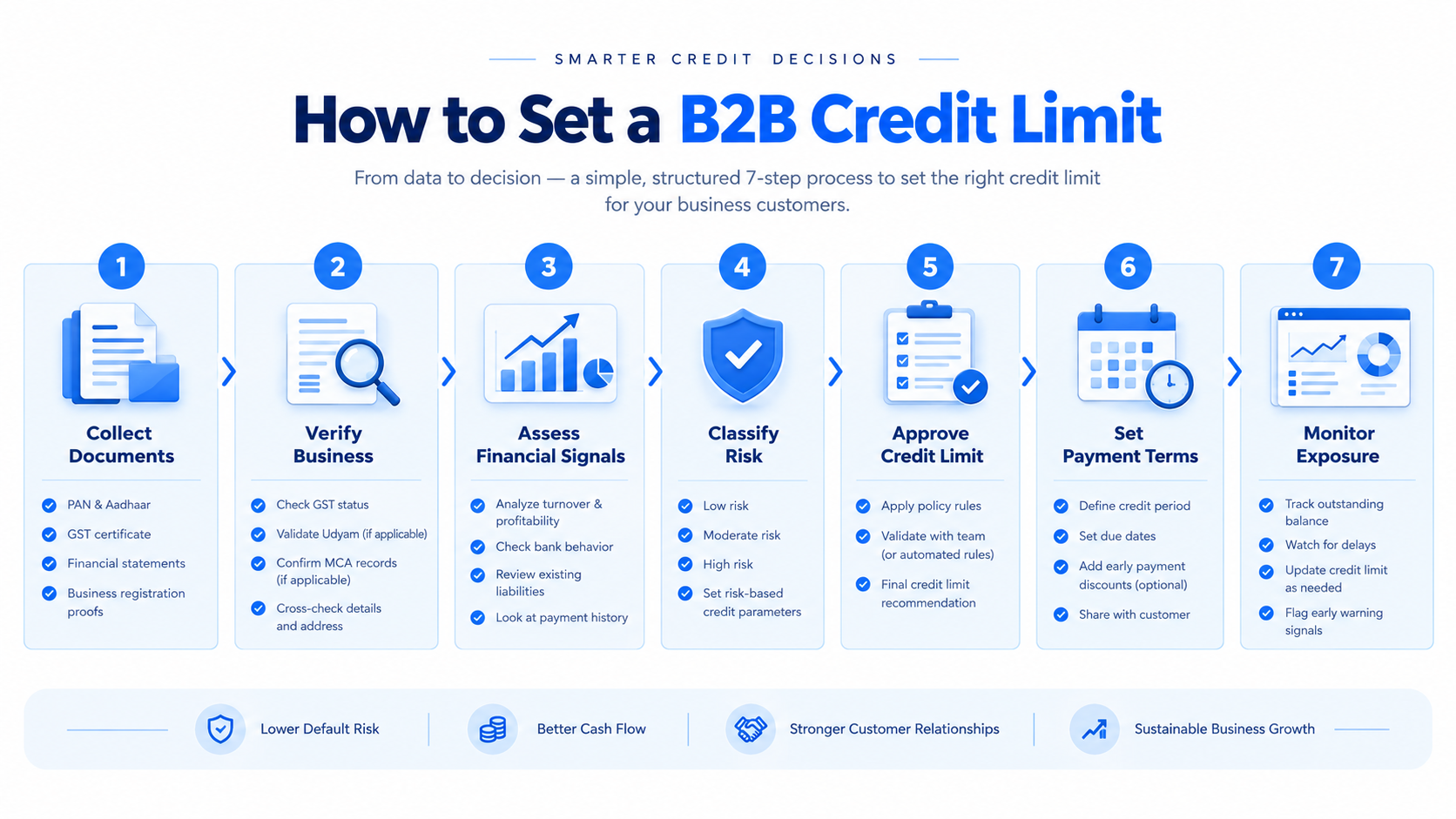
How do you actually determine a customer’s credit limit? Follow a structured process rather than a gut call:
- Collect documentation — GST certificate, Udyam registration (if applicable), PAN, recent financial statements, and trade references.
- Verify independently. Cross-check GST filing status, Udyam details, and MCA records rather than relying only on what the customer hands you.
- Assess financial and payment signals — review available financial ratios, existing debt load, and payment history with you or other suppliers.
- Classify the risk tier. Group the customer as low, medium, or high risk based on everything above.
- Run it through an approval workflow. Sales typically recommends a limit based on the relationship and order potential; credit-control verifies documentation and risk signals; finance gives final approval, especially above a defined threshold.
- Set an initial limit with conditions. For new or thinly documented MSME customers, start conservatively — maybe an advance deposit or a bank guarantee — until a payment track record builds.
- Document and communicate terms so there’s no ambiguity later. Put the credit limit, payment period, and any conditions in writing, every time.
Keeping sales, finance, and credit-control as separate checkpoints matters more than people think. Sales teams are incentivized to grow revenue, so they shouldn’t be the sole approvers of credit exposure. That’s a structural conflict, and it’s worth avoiding rather than managing around.
A Practical Example: Calculating a Customer Credit Limit
What’s a good credit limit for a B2B customer? There’s no universal number — it depends on order size, payment terms, and risk profile — but here’s one way to reason through a scenario.
Say a customer places average monthly orders worth ₹5 lakh, works on 30-day payment terms, and has been assessed as medium risk based on verification and payment history.
A practical — not formulaic — way to think about it:
- Start from the average monthly order value (₹5 lakh) as your baseline exposure
- Add a buffer for the 30-day payment cycle, since a customer ordering steadily will typically carry roughly one to one-and-a-half months of unpaid invoices at any given time
- Adjust downward for medium or high risk, and only push it upward once a consistent on-time payment history is established
- Cap the result at a level you’re comfortable losing entirely in a worst case, without it disrupting your own operations
For this customer, many businesses would land somewhere in the range of one to one-and-a-half times the average monthly order value as a starting credit limit, reviewing it after a few billing cycles. Treat any specific multiple as a starting assumption to test against your own risk appetite — not a fixed industry rule.
Avoiding Excessive Credit Exposure and Reviewing Limits Over Time
The simplest way to avoid excessive credit exposure is to cap it on purpose — per customer, and across any one industry or customer cluster. A few tactics that actually work.
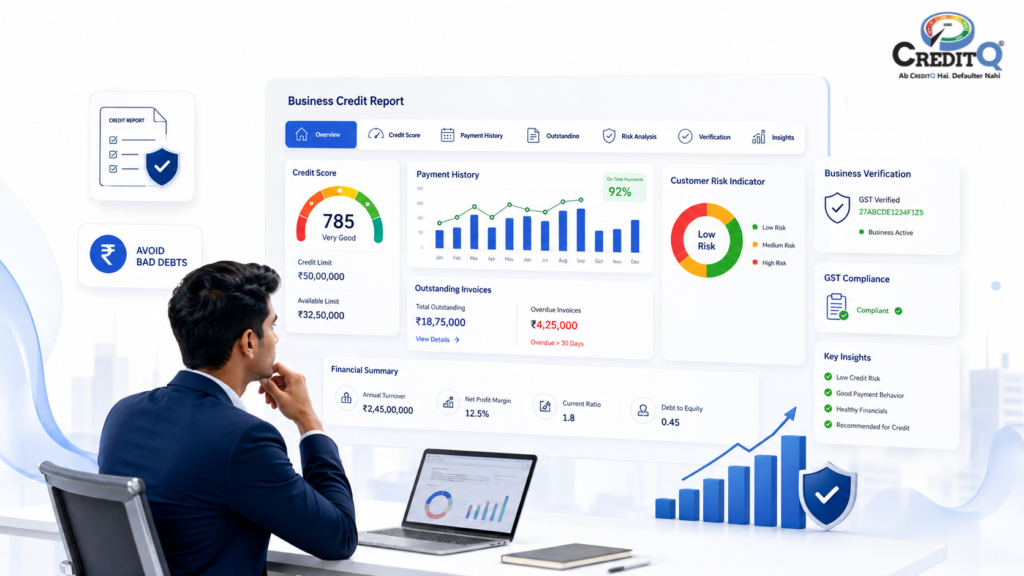
Effective business credit management helps suppliers track credit transactions, follow up on overdue payments and manage outstanding exposure.
- Set a maximum exposure ceiling per customer as a percentage of your total receivables
- Increase limits in stages for new or limited-history MSME buyers instead of handing out a large limit upfront
- Require deposits or bank guarantees for high-risk or high-value accounts
- Shorten payment terms — say, 15 days instead of 45 — for buyers with weaker risk profiles
- Diversify your customer base, so no single account can sink your cash flow if it defaults
How often should a business review customer credit limits? Most businesses do fine with a quarterly or annual review as a baseline, with event-triggered reviews layered on top. Watch for overdue invoices crossing a set number of days, bounced payments or dishonored cheques, adverse signals from business verification (GST filing lapses, for instance), or negative credit information surfacing from other sources.
What happens if a customer exceeds their credit limit? Usually, further credit just gets paused — new orders go on hold until outstanding dues come back within the approved limit, or until additional security is provided. Some businesses build in a small, pre-approved tolerance buffer for genuine timing mismatches, but that should stay the exception, not standard practice.
Common Mistakes to Avoid in B2B Credit Limit Management
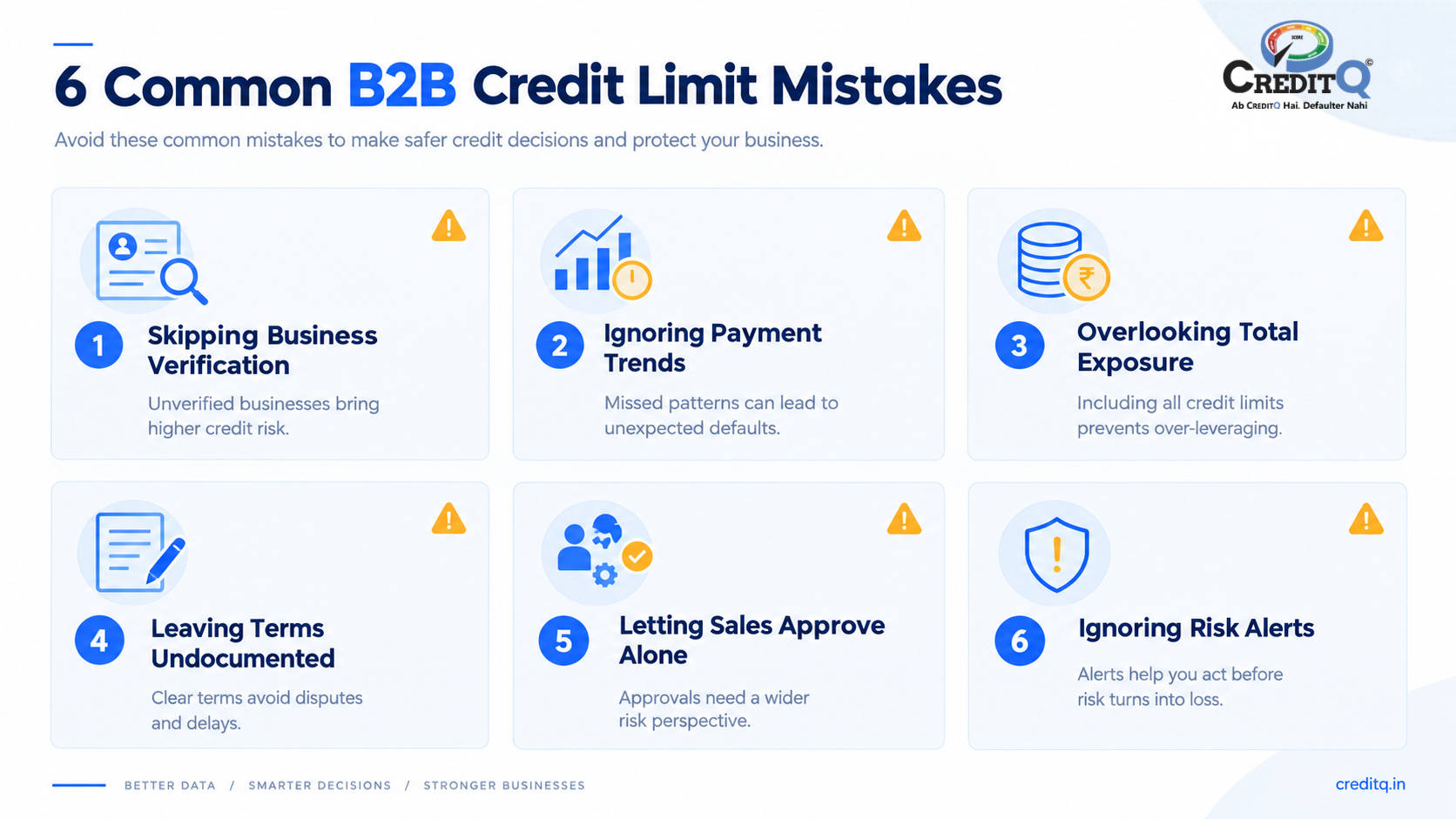
Even experienced credit teams fall into familiar traps. Watch for these:
- Setting limits without verification. Relying purely on a customer’s word or a long-standing relationship is tempting but risky. Fix: run GST/Udyam/MCA checks even for names you know well.
- Ignoring payment history trends. A customer who’s drifted from paying on day 20 to day 55 is telling you something. Fix: track days-sales-outstanding trends, not just whether invoices eventually get paid.
- Not monitoring exposure across customers. Focusing on individual accounts while total receivables quietly balloon is how things get out of hand. Fix: review aggregate exposure monthly, not just customer by customer.
- Failing to document terms clearly. Verbal agreements lead to disputes, almost every time. Fix: put credit limits and terms in writing.
- Letting sales set limits alone. Understandable given the incentives, but risky all the same. Fix: require finance or credit-control sign-off above a threshold.
- Not revisiting limits after red flags. A bounced payment should trigger an immediate review — not wait for the next quarterly cycle.
When a business identifies persistent payment defaults, it can review the available process for reporting business credit defaulters, subject to CreditQ’s requirements.
How CreditQ Helps Businesses Make Better Credit Decisions
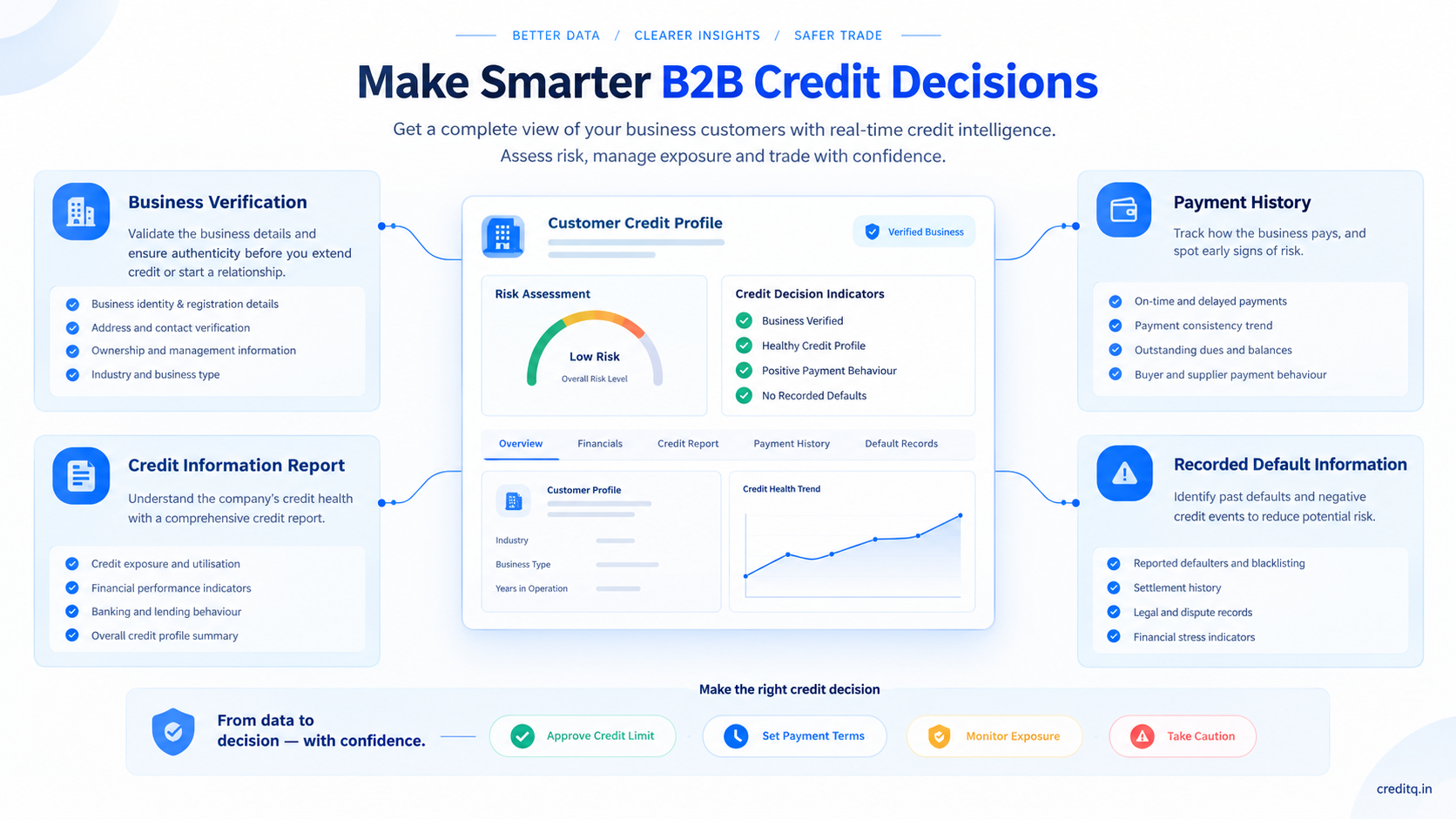
CreditQ positions itself as a business credit intelligence and credit management platform built to support exactly this kind of decision-making. Instead of chasing GST portals, MCA records, and payment references separately, businesses can use a platform like this to bring business verification, credit information, payment history patterns, and recorded default information into one place.
For credit managers and MSME owners, that generally means faster due diligence before onboarding a new customer, easier ongoing monitoring of existing accounts, and a more evidence-based way to decide whether a credit limit should go up, stay flat, or come down. Used well, credit intelligence tools don’t replace judgment — they inform it, giving sales, finance, and credit-control a shared, factual starting point instead of a gut-feel argument in a meeting room.
Conclusion and FAQs

Setting the right B2B credit limit isn’t about being conservative or aggressive. It’s about being deliberate. Verify your customers properly, base limits on real financial signals rather than relationship comfort, review them on a regular cadence, and move fast when red flags show up. Do this consistently and you’ll find you can extend trade credit with confidence, grow your customer base, and still sleep at night knowing your cash flow isn’t riding on hope. If you’re looking to strengthen this process with better verification and credit intelligence, exploring a platform like CreditQ is a sensible next step.
What is a good credit limit for B2B customers?
There’s no fixed number — it depends on the customer’s order volume, payment terms, and risk profile. A common starting point is setting the limit around one to one-and-a-half times average monthly order value, adjusted for risk, then refined as payment history builds.
How do you determine a customer’s credit limit?
>>>>>>>>>>Collect financial and registration documents, verify them independently (GST, Udyam, MCA where applicable), assess payment history and risk level, then route the recommendation through sales, credit-control, and finance for approval.
What factors affect B2B credit limit decisions?
>>>>>>>>>Key factors include business turnover, years in operation, industry risk, payment history, existing outstanding dues, financial statements, and verification signals like GST compliance and MCA filings.
How often should a business review customer credit limits?
>>>>>>>>>Most businesses review limits quarterly or annually, with additional reviews triggered immediately by events like overdue payments, bounced cheques, or adverse credit information.
What is the difference between credit limit and credit period?
>>>>>>>>>A credit limit is the maximum amount a customer can owe at once; a credit period is how many days they’re given to pay each invoice. They work together but measure different things.
What happens if a customer exceeds their credit limit?
>>>>>>>>>Typically, new orders or shipments are paused until the customer clears enough of the outstanding balance to fall back within the approved limit, or provides additional security.