
Running a Business isn’t all about selling; it’s a blend of timely payments in the book of any businesses and few or no payments mean disruption in cash flow, strained vendor relationships and adverse impact on the standing of a business. One of the ways to steer clear of this problem is to join in the business credit report with a well-thought-out payment reminder with the dealership. With both of these tools at hand, businesses are provided with the visibility as well as some control to handle receivables manually; hence, they do not have to keep a constant eye on their debtors.
Credit or long payment agreements to clients and partners should only be given upon a reliable financial assessment. Business credit reports present a clear financial picture, covering past performances, available fiscal reserves, and credit utilization of a company while highlighting any payment issues with its tenants in public data. Getting better information will help businesses make a decision rather than an assumption or oral assurance.
CreditQ provides owners the ability to view published credit data compiled directly from transactional lines of shopping. Understanding whether a potential client has a pattern of slow payments naturally goes a long way towards negotiating terms of credit, requesting payments upfront, or simply entering into business with a little caution. Domestic credit ratings should be favored most.
Understanding the Role of a Business Credit Report
As far as anything measured ending with the amount remaining unpaid, most smaller and medium-sized enterprises have remained caught up by temptations to resort to relatively informal methods. A phone call here, an e-mail there, and eventually we all forget about it or unnecessarily have it escalated. All these obstacles are found on the different standing planes between the asking party-client and everyone else on the lower end, the debtor.

A well-structured payment reminder mechanism ensures that every invoice is tracked right from the day of issue. E-mail reminders are triggered days before the first indicator of date to remind clients about a pending invoice. When a system does this, it becomes quite difficult for the receiving client to forget the terms of the invoice, which they would have when being bugged personally.
The composed workflow of the Payment Reminder virtually sets an open field of expectations, suggesting that your receivables are paramount to you and that they should be your main concern.
Manual follow-up consumes time. It is quite inconvenient for businesses to track all one or hundreds of invoices on a case-by-case basis. Auto Payment Reminders and Follow Up are very important.
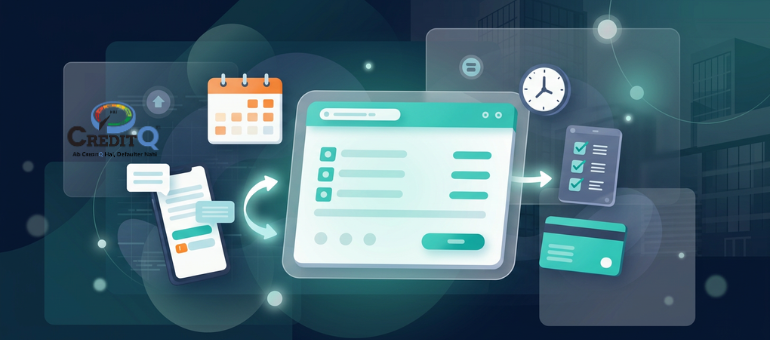
An automated system sends reminders according to predefined schedules. First, let’s say, seven days before the due date, a reminder on the due date, then additional reminders at regular intervals until the payment is made. There will be no faxing; nobody will have to manually remember, draft, and send communication. A field in which system control is carried out differently on the ground is hard to achieve through the sheer effort of men.
CreditQ has integrated that automation into the platform so that businesses can set reminder schedules for their invoices as per their terms and client relationships—$a reduction in missed follow-ups, faster collections, and less time lost on administrative chasing.
Why Payment Reminders Cannot Be an Afterthought
Business credit reports of a business client come very handy, long before the contract is inked. The reason for the value of that credit history does not end there. When a payment is divided in half, this credit history sometimes becomes the key to answering such questions. Such as, is this a client who frequently bids away at the eleventh hour across all its vendors, or is this an isolated issue that inclines toward a much softer follow-up?

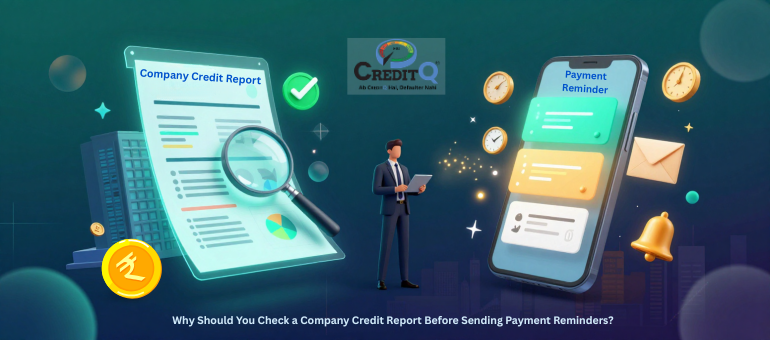
CreditQ enables businesses to cross-refer the payment behavior and adjusts their reminder & escalation strategy. A client with strong credit might be sent a simple Payment Reminder–and pay promptly–, while one that hasn’t paid before could receive a secondary correspondence far sooner.
In this case, the data-driven approach stands against intuitive action.
Reducing Default Rate Through Proactive Steps
Waiting for the invoice to become overdue in 60 or 90 days for complete action is an expensive and irresponsible way to conduct business. The passage of time leads to legal challenges in collecting those very same amounts, invoking the involvement of lawyers and collectors, who charge extra and consume a substantial part of the due amount.
The Auto Payment Reminder and Follow Up model operates beautifully for the simple reason that it handles potential delays before they turn into serious problems. Continuous communication at an early stage suggests to clients that your business closely monitors accounts receivable, which often puts pressure on them to pay.
CreditQ also nurtures such proactiveness in business through combining credit scoring and automated follow-up within an operational workflow; that is to say, credit checks and invoice management flow combined within a risk management approach rather than being handled as separate activities.
Protecting Your Business Reputation and Relationships
Many entrepreneurs worry about the possible harm issuing a payment reminder could do to relationship management. In general, the opposite is often true. Clients tend to respect greater clarity, and the timely reaction from the firm often presents a better impression. The obverse occurs when follow-ups are done consistently.

A successfully designed Auto Payment Reminder and Follow Up system was aimed at carrying out a professional attitude as far as the collections process is concerned. All messages are required to be polite, factual, and punctual. They should serve reminder purposes and not harassment purposes; they create a paper trail as a basis of proof in case disputes occur.
Certainly, with the Business Credit Report, businesses also may understand which relationships are worth preserving by offering flexible terms, and which are so bad as to warrant stricter credit conditions.
Read Also : What is the Role of Payment Reminders in Improving Debtor Payment Settlement?
Frequently asked questions
Q1. What is a Business Credit Report for and what is its importance to invoice management?
Ans: A Business Credit Report is a summary of a company’s credit history, including payment history, bills due, and credit behavior. In the context of invoice management, though, it is used to estimate in advance the credibility, as to the likelihood of repaying on time, of a client inquiring about what credit terms to extend.
Q2. How an Auto Payment Reminder and Follow Up system can save on the number of overdue invoices.
Ans: An Auto Payment Reminder and customized follow-up routines will send alternate notifications at specific intervals before and after an account’s payment deadline. This ensures that fewer invoices are overlooked, therefore, the collections timeline improves quite noticeably.
Q3. Are small enterprises better off implementing CreditQ?
Ans: Absolutely. CreditQ caters for large to small businesses. Since small businesses could possibly go without a specific credit management team, automated solutions and credit data become especially crucial in cash flow protection!
Q4. Is it possible for clients to tweak the following reminders in accordance with different deadlines?
Ans: Most systems allow CreditQ clients the opportunity to customize reminder schedules in line with such parameters as invoice value, client credit history, and payment due dates. The most demanding situations will warrant your adaptable approach.
Q5. What happens if a Payment Reminder fails to effect a payment?
Ans: If a Payment Reminder cycle is completed without response, the system typically escalates the case for manual review or formal action. Having the communication history automated also strengthens any legal or dispute resolution process that follows.