
Settlement from Buyer decides how quickly a completed sale becomes working cash. Many Indian suppliers wait 45 to 90 days or longer, which strains payroll, raw material purchases, and growth plans. Late payment is rarely about one difficult buyer. It usually points to gaps in terms, documentation, and follow-up. This guide explains how B2B businesses can shorten that wait, and how CreditQ, India’s 1st Business Credit Management & Information Platform, supports the process.

How Can Businesses Speed Up Settlement from Buyers
Secure Your Business Payments Now
Quick Answer
You can speed up payments by keeping each deal in writing, checking the buyer’s business credit profile before you offer terms, raising correct invoices on time, using a steady reminder system, and checking dues each week. CreditQ brings these steps into one place.
What Is CreditQ?
CreditQ is India’s 1st Business Credit Management and Information Platform. It helps suppliers and buyers start a business transaction and receive an acknowledgement. This way, both sides keep the same record from day one.
Core services on CreditQ
- Company credit reports
- Business credit reports
- MSME defaulter settlements
- Automated payment reminder and follow-up
Why Do Buyers Pay Late?
When you know what drives the delay, you can pick a better fix. Common causes include:
- No shared record that the order, delivery, or service was accepted
- Invoice issues like wrong tax details or no purchase order number
- Payment terms that are unclear or never written down
- Slow internal approvals on the buyer’s side
- No follow-up after the due date passes
Most of these points are within your control. A disputed or unacknowledged transaction often ends up paid late.
How Can You Get Paid Faster? 7 Practical Steps
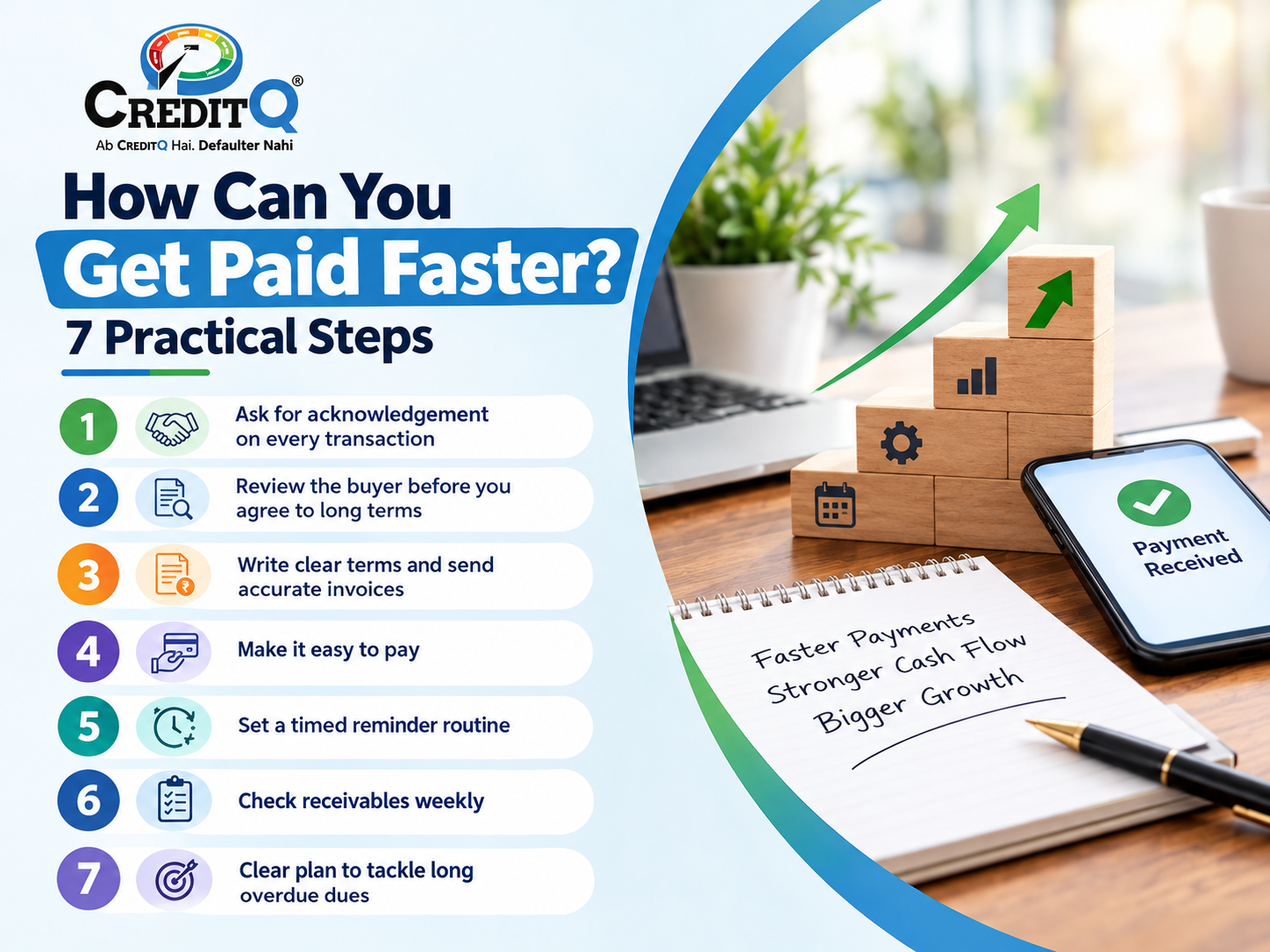
1. Ask for acknowledgement on every transaction
A lot of delays start when there is confusion about what was ordered or what was delivered. When you start a transaction on CreditQ, the buyer acknowledges it. That acknowledgement creates a clear trail. With that trail, disputes drop, and payment delays also drop.
2. Review the buyer before you agree to long terms
Long payment cycles can be risky if you have not checked the buyer. Look at a company credit report or a business credit report before you offer extended terms. CreditQ provides both, so you can decide which buyers get normal terms and which buyers need tighter terms.
3. Write clear terms and send accurate invoices
Make sure your quotation, contract and invoice all have due dates, payment methods and any late fee rules. Send the invoice on the day of delivery. Use Correct GSTIN, Purchase Order No., Item Details and Bank Details. If the invoice is clean, it passes the buyer’s approval steps with fewer returns.
4. Make it easy to pay
Every extra step can delay a purchase. Make it easy to pay with UPI, NEFT, RTGS and Card Payments. Every invoice should include a payment link or QR code. You may also want to offer a small early payment discount, maybe 1 to 2 percent, to entice those who tend to pay at the last minute.
5. Set a timed reminder routine
A reminder that comes at the right time often works better than a hard email after long silence. Use a simple cadence:
- 3 days before the due date: a quick friendly note
- On the due date: a short confirmation message
- 3 days after: a polite follow-up, with the invoice attached
- 7 days after: a call to the accounts contact
- 15 days after: a formal written notice
Doing this by hand eats up hours each week. With CreditQ, the auto payment reminder and follow up feature sends the scheduled messages for you. That means fewer missed invoices and a steady tone across every account.
6. Check receivables weekly
Look at an aging report and group unpaid invoices into 0 to 30 days, 31 to 60 days, 61 to 90 days, and 90+ days. Also watch Days Sales Outstanding (DSO). DSO helps you see how long it takes to receive payment on average.
- DSO formula = (Accounts receivable ÷ Total sales on account) x Days in period
- If DSO is declining, you are speeding up your payment flow
- If DSO is increasing, it is a sign to act early
7. Clear plan to tackle long overdue dues
Some customers pay nothing for months even after sending reminders. In such cases, a clean process saves you time and keeps your records in order.MSME defaulter settlements fall under CreditQ, a way for small and medium suppliers to document how they handle overdue accounts.
Why Choose CreditQ for Buyer Payments?
Most finance teams still rely on spreadsheets, emails, and calls for buyer payments. That setup can work for a few accounts, but it gets messy as the business grows. CreditQ brings those tasks into one place, made for Indian B2B trade.
Regular use of it enhances settlement from buyers by keeping a record for each transaction, a profile for every buyer and a follow-up path for past-due invoices.
Key benefits:
- Deal verification, reduced dispute risk
- Company and business credit report buyer profiles
- Automated follow-ups so your team can focus on other tasks
- Institutional mechanism for settlements of MSME defaulters
- Regular updates across all buyer profiles
What Mistakes Slow Down Buyer Payments?
Even strong businesses tend to repeat a few patterns that delay payment:
- Sending invoices days or weeks after delivery
- Extending terms without checking the buyer’s background
- Waiting to follow up until the due amount becomes big
- Ignoring small overdue amounts until they grow
- Using a harsh tone that harms trust
- Fixing just two or three of these can cut your payment timeline.
Conclusion
Faster Settlement from Buyer is rarely about pushing harder. It comes from agreeing on the sale early, knowing your buyer, invoicing accurately, and following up on a steady rhythm. Businesses that build this routine enjoy steadier cash flow and fewer awkward conversations. A platform like CreditQ can carry much of that routine for you, from transaction acknowledgement to credit reports and automated follow-up.
Must Read: What Is a Company Credit Report and Why Does It Matter?
Frequently Asked Questions
Q1. How can a business speed up buyer payments?
Ans: Agree on terms in writing, send accurate invoices on the day of delivery, offer easy payment options, and follow up on a fixed schedule. Reviewing unpaid invoices weekly keeps small delays from growing.
Q2. What is the best time to send a payment reminder?
Ans: The first message works best about three days before the due date, followed by one on the due date itself. After that, follow up at three, seven, and fifteen days if the invoice is still open.
Q3. What does CreditQ offer to businesses?
Ans: CreditQ is India’s 1st Business Credit Management & Information Platform. It lets suppliers and buyers initiate and acknowledge business transactions, and it provides company credit reports, business credit reports, MSME defaulter settlements, and automated follow-up.
Q4. Why check a business credit report before selling on payment terms?
Ans: It shows how a company has handled its dues with other suppliers. This helps you decide how much time to allow and which buyers need shorter terms.
Q5. What is a reasonable payment term for B2B sales?
Ans: Net 15 to net 30 days is common. Shorter terms suit new or unverified buyers, while longer terms can suit established, repeat accounts.